email: info(at)go-eu.com
phone: +49 (0)89 90 42 23 60




assisted in a company setup.


The CEO from GO EU
Table of contents:
- Why do foreigners choose Romania?
- Step 1 Choose the right business structure
- Step 2 Reserve your company name
- Step 3 Prepare documentation
- Step 4 Open a bank account
- Step 5 Register with Trade Register (ONRC)
- Step 6 Tax registration
- Step 7 Obligations
- Special considerations
- Timing and cost expectations
- Tips for a effortless formation
- Why Romania is worth it
- Conclusion
How to Start a Business in Romania as a Foreigner - Step-by-Step Guide (2026)
09 May 2026 5732 4Why Do Foreigners Choose Romania?
Romania is recognized as one of the most attractive destinations for a Company Formation Romania in Europe for entrepreneurs, especially foreign founders. With EU membership, competitive costs, and flexible company structures, it can be an excellent place to launch and grow a business.
1) EU membership and market access
A Romanian company can trade and operate across the EU single market. While procedures are still national, the EU framework makes cross-border trade and services easier to access. Moving to Romania is only option, but not necessary.
2) Competitive taxes and operating costs
Romania offers multiple taxation options depending on your revenue and business model, including micro-company regimes for qualifying businesses and a standard corporate income tax regime.
3) Low minimum share capital
The SRL (limited liability company) can be formed with a very low share capital, allowing access to startups and small teams.
4) No general foreign ownership restrictions
In most cases, foreigners can own and control Romanian companies without a local partner. This is one reason Romania remains attractive to international entrepreneurs.
Step 1: Choose the Right Business Structure
The first strategic decision is your legal form. This impacts liability, tax, governance, and continuous compliance. The most common options are:
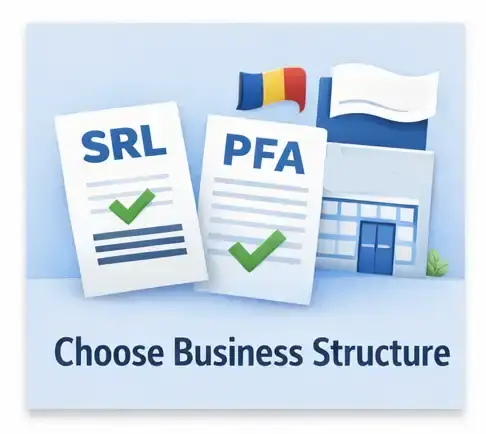
- SRL (Limited Liability Company) — the standard choice for most foreign founders.
- PFA (Authorized Person) — similar to sole proprietor; often suited to freelancers.
- Branch / Representative Office — extensions of a foreign entity for specific use cases.
- SA (Joint-stock company) — more complex; usually for larger structures.
For most non-resident founders building an SME, an SRL is typically the best balance between simplicity and protection.

Tel.: +49 (0)89 90 42 23 60
Receive more Infos ➔ Free initial consultation
Step 2: Reserve Your Company Name
You need to reserve a unique company name before filing. The name is checked against existing entries at the National Trade Register Office (ONRC).
- Prepare 2–3 backup names.
- Avoid confusingly similar names.
- Some keywords may require extra approvals depending on the sector.
Once approved, name reservations are typically valid for a limited period, so plan your following steps in advance.
Step 3: Prepare Documentation and Legal Requirements
Romania requires an incorporation package. The exact documents vary by structure and founder situation, but commonly include:
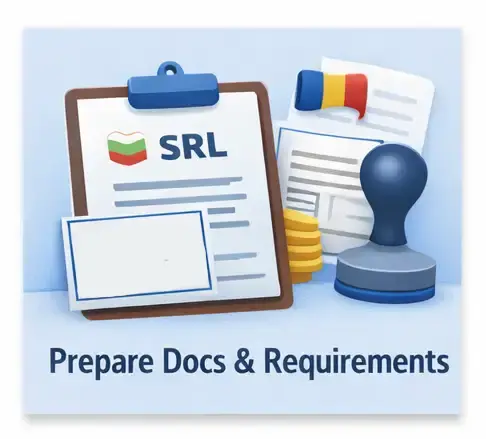
- Articles of Association (Company Statute)
- Shareholder details and ownership structure
- Administrator/manager appointments
- Registered office proof (lease, consent, or service agreement)
- Share capital subscription/deposit details
If documents are signed abroad, expect notarization, apostille/legalization, and a certified translation. This is where local professional help often saves the most time.
Step 4: Open a Bank Account and Handle Capital Requirements
You may need a bank account to deposit share capital and later to operate. Banks apply KYC/AML checks and may request:

- Identification documents for shareholders and administrators
- Proof of address
- Business description and expected transactions
- Source-of-funds documentation
Some banks allow remote onboarding in limited cases, but others may require in-person presence, especially for non-EU founders. After depositing share capital, the bank issues a certificate used in the incorporation file.
Step 5: Register with the National Trade Register Office (ONRC)
With your documents prepared and capital steps handled, you submit your file to ONRC. The registration procedure generally includes:
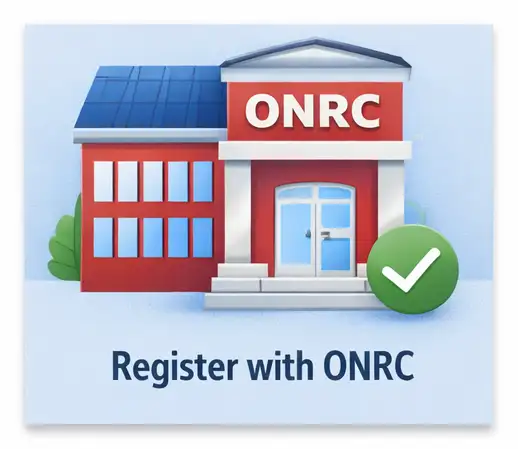
- Submission of incorporation package
- Formal verification for compliance
- Issuance of the Certificate of Incorporation (if approved)
Timelines can vary, but well-prepared applications can often be processed within a week. Delays usually stem from missing documents, incorrect translations, or differences in addresses and banking details.
Step 6: Tax Registration and Post-Registration Tasks
After incorporation, your company must be set up correctly for tax and accounting purposes. Depending on the structure, the company will interact with the National Agency for Fiscal Administration (ANAF).
VAT registration (TVA)
VAT can become mandatory above certain turnover thresholds. Voluntary VAT may be possible depending on your business model. (EU trade, B2B services, imports). VAT registration impacts reporting frequency and compliance requirements.
Payroll and social contributions
If you hire employees, you’ll need payroll registration and correct monthly filings for income taxes and social contributions. Set this up before hiring to prevent fines.
Step 7: Comply with Ongoing Obligations
Incorporation is only the start. Romanian companies generally need consistent bookkeeping and periodic filings. Typical obligations can include:
- Accounting records and invoices
- Corporate tax filings
- VAT returns (if registered)
- Annual financial statements
- Payroll and social contributions filings (if you have staff)
A Romanian accountant is not optional for most foreign founders; it’s a core part of ensuring regulatory adherence and operating safely.
Tel.: +49 (0)89 90 42 23 60
Receive more Infos➔ Free initial consultation
Special Considerations for Foreigners
EU vs non-EU founders
EU citizens can usually live and work in Romania with minimal formalities, while non-EU founders who want to reside locally may need appropriate visas/residence permits. Company ownership and company management are separate from immigration status.
Language and documents
Romanian is the official language for filings and many authorized communications. Use certified translations and ensure legal formats match Romanian practice.
Timing and Cost Expectations
Timeframe
With documents prepared and banking handled efficiently, formation can often be completed within 1–2 weeks. Complex cases (non-EU founders, extensive translations, VAT registration) may take longer.
Costs
Romania is cost-efficient, but real-world costs typically include notary fees, translations, accounting, banking, and registered office services (if needed). Budget realistically to prevent holdups.
Tips for a Easy Setup
- Prepare early: collect IDs, proof of address, and business details before starting.
- Use local help: a lawyer for documents and an accountant for tax/compliance saves time.
- Plan banking: AML checks can slow things down bring full documentation.
- Think compliance first: set up bookkeeping and filing reminders from day one.

Why Romania Is Worth It
Romania offers EU access, flexible company structures, competitive tax options, and a growing economy. It can be a strong base for serving EU clients, building a regional hub, or hiring talent in sectors such as IT and services.

Conclusion: Start Your Business in Romania with Confidence
Starting a company in Romania as a foreigner is completely attainable with proper planning. Focus on the fundamentals: choose the correct structure, secure a registered office, prepare documents and translations properly, plan for banking and share capital, and build compliance workflows early.
Tel.: +49 (0)89 90 42 23 60
Receive more Infos➔ Free initial consultation
Leonardo
Published on 21 December, 2025 / Answer
Is it still a good idea to incorporate a company in Romania in 2026?
Zacharius
Published on 22 December, 2025 / Answer
The taxes go up from 10% dividend tax to 16% on 1st Jan 2026, and the Micro Company Regime only up to 100k per year to be in the threshold. If you organize it correctly, you can go for 10% income tax. I did that, and I am prepared for 2026, paying only 10% in total tax with no limit on yearly revenue.
Mark
Published on 29 December, 2025 / Answer
To do that (paying only 10% tax in total), you have to open a PFA (personal company, not corporation), or how does it work?
Thomas Hofmann
Published on 29 December, 2025 / Answer
You open up a US LLC and get that company approved by ANAF (Romanian tax authority) to be accepted to pay only income tax and not dividend tax. In the US, you pay 0% tax, while in Romania, you pay just 10% income tax. So, in total, a 10% tax. We can get that approved by the ANAF by ruling out the operating agreement of the US LLC and presenting that to ANAF properly. They will accept it; we have done that many times until today.
Leave a comment